Reimagining the Aura: How Luxury Reconstructs Meaning Under Sensory Scarcity

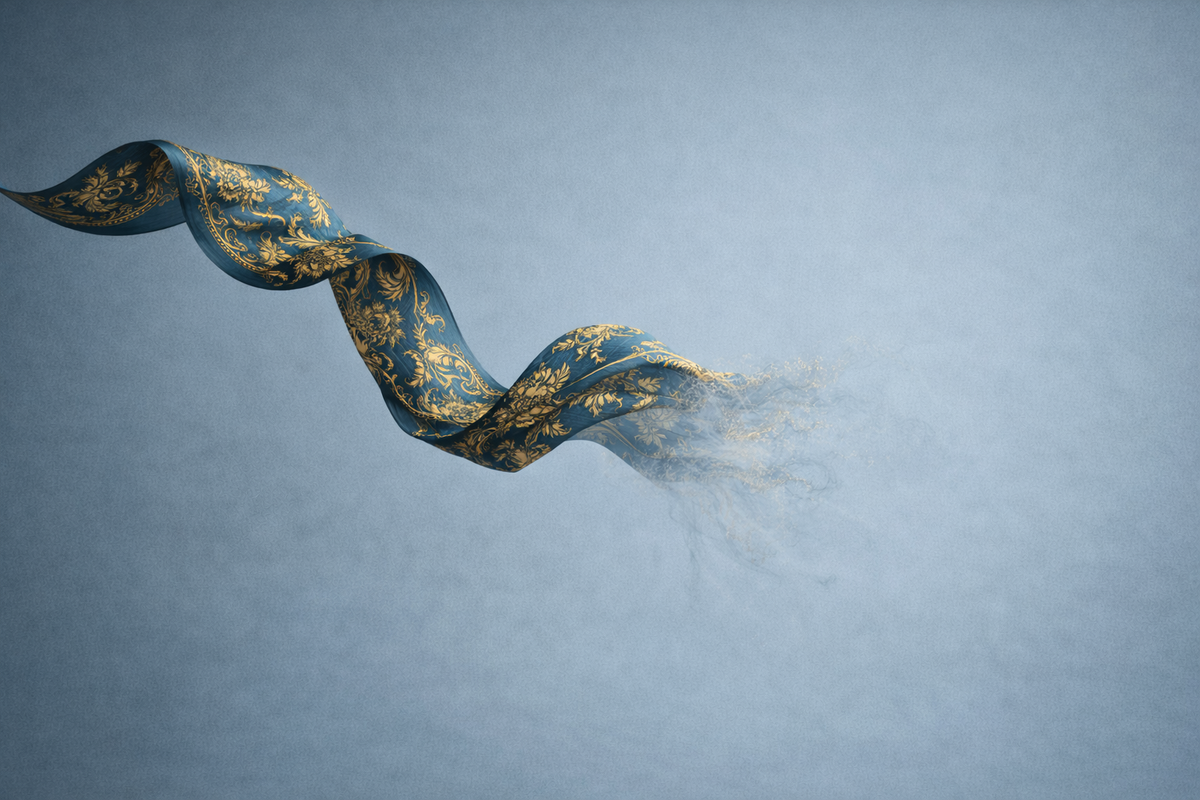
The disappearance of touch may be altering luxury in ways that are less obvious — and more enduring — than expected.
Luxury once relied on the body.
Weight, texture, resistance, scent — these were not embellishments so much as signals. To encounter luxury was often to feel it assert itself through material presence, through friction as much as form. Ownership was legible because it could be sensed.
Digital consumption unsettles that certainty. Screens smooth surfaces. Interfaces remove resistance. Objects increasingly arrive as images, narratives, and mediated encounters rather than things to be handled. In this environment, luxury is frequently described as diminished — its authority weakened by the absence of material and sensory cues.
That assessment is understandable. It may also be incomplete.
Luxury has rarely depended on material abundance alone. Distance, delay, and what is withheld have long played a role in how luxury meaning is formed. What appears today as loss may, in some cases, be better understood as a reorganisation of how meaning is produced.
Luxury’s aura has not disappeared. It appears to be shifting.
Why digital luxury is often misunderstood
Much contemporary discussion of digital luxury is organised around absence. What cannot be touched is assumed to matter less. What cannot be smelled, worn, or physically encountered is framed as lacking authenticity. From virtual showrooms to digital fashion, the recurring question is whether technology can replicate the sensory richness of physical luxury — and when it cannot, the conclusion is often pessimistic.
This way of thinking rests on a narrow idea of aura. It treats aura as something that emerges automatically from proximity to the object, as though material uniqueness alone were sufficient to generate meaning. Historically, luxury has rarely worked so cleanly. Its authority has often relied as much on distance as on presence, as much on imagination as on access.
Luxury has never been only about possession. It has also involved withholding.
What digital environments make more visible is not the disappearance of aura, but how little it was ever reducible to sensory saturation in the first place. When material cues recede, other mechanisms tend to come forward. Meaning does not vanish. It reorganises.
When less sensation creates more meaning
In dematerialised contexts, consumers encounter luxury under conditions of constraint. They are offered fragments rather than totality: an image instead of an object, a story instead of a surface, a suggestion of form rather than its full sensory reality. This scarcity is often treated as a problem to be solved. Brands respond by adding layers of stimulation — video, sound, immersive interfaces — in an effort to compensate.
Yet scarcity itself can be productive.
When sensory information is incomplete, imagination becomes active. Consumers infer, project, and elaborate. They do not simply receive meaning; they participate in its construction. Absence creates space for anticipation and emotional investment. Luxury shifts from something that overwhelms the senses to something that invites them to work.
This dynamic is not unique to digital consumption, but digital environments intensify it. The absence of touch or weight redirects attention toward narrative, symbolism, and personal association. Luxury becomes less about what is presented in full and more about what is suggested. Meaning emerges not from saturation, but from restraint.
Under these conditions, aura is no longer anchored solely to the object. It becomes distributed across the relationship between consumer, image, and imagination.
How consumers complete what they cannot touch
Without the grounding force of material presence, narrative takes on greater importance. Stories about origin, craft, intention, and exclusivity do not merely supplement the object; they help stabilise meaning when sensory proof is unavailable.
Through carefully constructed storytelling, brands invite consumers into worlds that feel coherent and intentional. Engagement becomes less about verifying authenticity through the senses and more about recognising oneself within a symbolic universe.
This process is not passive. Consumers actively fill sensory gaps with memory, desire, and association. The absence of full information encourages completion. In doing so, individuals become partial authors of the luxury experience.
When meaning is partly self-generated, attachment can deepen. The object — or experience — becomes a site of projection rather than a finished statement. Its value is felt not because it overwhelms, but because it resonates.
Intimacy without closeness
One of the quieter paradoxes of digital luxury is that it can feel intimate without being close. Physical distance does not necessarily produce emotional detachment. In some cases, the removal of sensory immediacy appears to heighten personal connection.
This intimacy often emerges through selective disclosure. Rather than presenting everything, luxury in dematerialised contexts reveals just enough to invite curiosity. Silence, ambiguity, and gaps are not failures of communication; they can function as tools. What is withheld acquires weight.
In this respect, digital luxury echoes a dynamic long familiar to prestige. Historically, luxury objects were not immediately accessible to all senses or all people. Distance, delay, and ritual shaped desire. Digital scarcity operates differently, but it activates similar psychological mechanisms.
The difference is that intimacy is no longer anchored to physical proximity. It becomes anchored to emotional alignment. Consumers feel connected not because they can touch the object, but because they recognise themselves in the meaning it offers.
What aura becomes after the object
If aura once depended on physical uniqueness, its contemporary reconstruction appears increasingly tied to emotional singularity. In dematerialised environments, luxury distinguishes itself not through sensory excess, but through symbolic coherence and restraint.
Materiality still matters. Physical objects remain central to luxury’s ecosystem. But their meaning is increasingly shaped elsewhere — online, in anticipation, in discourse. The digital does not replace the material; it reframes it.
Aura becomes less about presence and more about potential. It resides in what the object promises rather than what it immediately delivers. The luxury experience unfolds across time rather than space. Anticipation, imagination, and delay take on greater significance.
This reconstruction is not automatic. It requires discipline. When brands attempt to compensate for dematerialisation by overloading consumers with stimulation, meaning can flatten. Excessive visibility erodes mystery. Constant availability undermines distinction.
In post-material contexts, aura seems to depend as much on what is withheld as on what is shown.
What this changes for brands — and for consumers
These shifts carry implications for how luxury value is produced and perceived. Authenticity can no longer be secured through material proof alone. It increasingly needs to be felt rather than demonstrated. Meaning moves from object to experience, from possession to perception.
Brands that equate digital sophistication with sensory immersion may misunderstand the opportunity. The task is not to replicate physical experience at all costs, but to design for emotional resonance under constraint. Silence and ambiguity are not weaknesses; they can function as strategic assets.
Traditional measures of success struggle here. Engagement captures activity, not meaning. Visibility does not guarantee aura. In some cases, overexposure accelerates symbolic erosion. As luxury becomes more accessible, its ability to feel special may depend increasingly on its capacity to resist total transparency.
For consumers, value is reframed. Ownership is no longer the sole endpoint. Proximity, access, and identification can carry emotional weight even in the absence of possession. Luxury becomes something one aligns with, rather than simply acquires.
Reading the present, anticipating what follows
What is unfolding is not the decline of luxury under digital conditions, but its transformation. Dematerialisation has not stripped luxury of meaning; it has redistributed how meaning is made. Sensory scarcity has made visible something that was always present: luxury’s reliance on imagination, distance, and interpretation.
The implications are still unfolding. But one pattern is becoming easier to discern. The brands that endure are unlikely to be those that become louder or richer in stimuli by default. They will be those that understand restraint as a form of power — those willing to withhold, to slow down, and to leave space for meaning to take shape.
Luxury’s future may not overwhelm the senses.
It may ask them to linger.